discover · compare · collections · requirements · contribute · feed · watching · stats · help with your tokens
kennethreitz/records · source
Snapshot 0 · 2026-11-04T12:47:23Z · Python · ISC
Content fingerprint
48b11920aee9215f610d3b9cd07e2b36d5a4be5c1159d93804a30456d9e1c16bGitHub description at capture
SQL for Humans™
README at capture
# Records: SQL for Humans™
[](https://pypi.python.org/pypi/records)
**Records is a very simple, but powerful, library for making raw SQL
queries to most relational databases.**

Just write SQL. No bells, no whistles. This common task can be
surprisingly difficult with the standard tools available. This library
strives to make this workflow as simple as possible, while providing an
elegant interface to work with your query results.
*Database support includes RedShift, Postgres, MySQL, SQLite, Oracle,
and MS-SQL (drivers not included).*
## ☤ The Basics
We know how to write SQL, so let's send some to our database:
``` python
import records
db = records.Database('postgres://...')
rows = db.query('select * from active_users') # or db.query_file('sqls/active-users.sql')
```
Grab one row at a time:
``` python
>>> rows[0]
<Record {"username": "model-t", "active": true, "name": "Henry Ford", "user_email": "model-t@gmail.com", "timezone": "2016-02-06 22:28:23.894202"}>
```
Or iterate over them:
``` python
for r in rows:
print(r.name, r.user_email)
```
Values can be accessed many ways: `row.user_email`, `row['user_email']`,
or `row[3]`.
Fields with non-alphanumeric characters (like spaces) are also fully
supported.
Or store a copy of your record collection for later reference:
``` python
>>> rows.all()
[<Record {"username": ...}>, <Record {"username": ...}>, <Record {"username": ...}>, ...]
```
If you're only expecting one result:
``` python
>>> rows.first()
<Record {"username": ...}>
```
Other options include `rows.as_dict()` and `rows.as_dict(ordered=True)`.
## ☤ Features
- Iterated rows are cached for future reference.
- `$DATABASE_URL` environment variable support.
- Convenience `Database.get_table_names` method.
- Command-line <span class="title-ref">records</span> tool for
exporting queries.
- Safe parameterization:
`Database.query('life=:everything', everything=42)`.
- Queries can be passed as strings or filenames, parameters supported.
- Transactions: `t = Database.transaction(); t.commit()`.
- Bulk actions: `Database.bulk_query()` &
`Database.bulk_query_file()`.
Records is proudly powered by [SQLAlchemy](http://www.sqlalchemy.org)
and [Tablib](https://tablib.readthedocs.io/en/latest/).
## ☤ Data Export Functionality
Records also features full Tablib integration, and allows you to export
your results to CSV, XLS, JSON, HTML Tables, YAML, or Pandas DataFrames
with a single line of code. Excellent for sharing data with friends, or
generating reports.
``` pycon
>>> print(rows.dataset)
username|active|name |user_email |timezone
--------|------|----------|-----------------|--------------------------
model-t |True |Henry Ford|model-t@gmail.com|2016-02-06 22:28:23.894202
...
```
**Comma Separated Values (CSV)**
``` pycon
>>> print(rows.export('csv'))
username,active,name,user_email,timezone
model-t,True,Henry Ford,model-t@gmail.com,2016-02-06 22:28:23.894202
...
```
**YAML Ain't Markup Language (YAML)**
``` python
>>> print(rows.export('yaml'))
- {active: true, name: Henry Ford, timezone: '2016-02-06 22:28:23.894202', user_email: model-t@gmail.com, username: model-t}
...
```
**JavaScript Object Notation (JSON)**
``` python
>>> print(rows.export('json'))
[{"username": "model-t", "active": true, "name": "Henry Ford", "user_email": "model-t@gmail.com", "timezone": "2016-02-06 22:28:23.894202"}, ...]
```
**Microsoft Excel (xls, xlsx)**
``` python
with open('report.xls', 'wb') as f:
f.write(rows.export('xls'))
```
**Pandas DataFrame**
``` python
>>> rows.export('df')
username active name user_email timezone
0 model-t True Henry Ford model-t@gmail.com 2016-02-06 22:28:23.894202
```
You get the point. All other features of Tablib are also available, so
you can sort results, add/remove columns/rows, remove duplicates,
transpose the table, add separators, slice data by column, and more.
See the [Tablib Documentation](https://tablib.readthedocs.io/) for more
details.
## ☤ Installation
Of course, the recommended installation method is
[pipenv](http://pipenv.org):
$ pipenv install records[pandas]
✨🍰✨
## ☤ Thank You
Thanks for checking this library out! I hope you find it useful.
Of course, there's always room for improvement. Feel free to [open an
issue](https://github.com/kennethreitz/records/issues) so we can make
Records better, stronger, faster.
--------------
[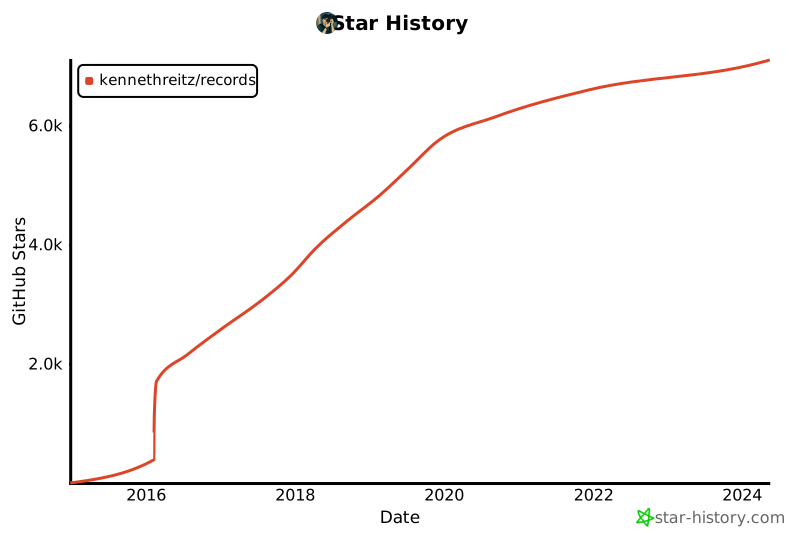](https://star-history.com/#kennethreitz/records&Date)