discover · compare · collections · requirements · contribute · feed · watching · stats · help with your tokens
clubpay/ronykit · source
Snapshot 0 · 2026-11-04T12:47:26Z · Go · BSD-3-Clause
Content fingerprint
e61e60339a9c2f5f04ab44e5e35d8471d90ee6ac61eec27a645981c718a788f3GitHub description at capture
API Framework supporting REST and RPC.
README at capture
# RonyKIT
[](https://codecov.io/gh/clubpay/ronykit)
[](https://app.fossa.com/projects/git%2Bgithub.com%2Fclubpay%2Fronykit?ref=badge_shield&issueType=license)
[](https://app.fossa.com/projects/git%2Bgithub.com%2Fclubpay%2Fronykit?ref=badge_shield&issueType=security)
[](https://goreportcard.com/report/github.com/clubpay/ronykit)
RonyKIT is a Go toolkit for high-performance API servers. Define service contracts one time. Use them to create type-safe handlers, API documentation, and client stubs.
## Quick start
### 1. Install the scaffolding tool
Install with Homebrew on macOS or Linux:
```bash
brew install clubpay/tap/ronyup
```
[Homebrew 6 and later](https://docs.brew.sh/Tap-Trust) requires explicit trust for third-party taps. The fully qualified name trusts the tap and installs `ronyup` in one step.
Upgrade `ronyup` with this command:
```bash
brew upgrade clubpay/tap/ronyup
```
You can also install with Go:
```bash
go install github.com/clubpay/ronykit/ronyup@latest
```
### 2. Create a project and workspace
Use interactive setup:
```bash
rony setup
```
Or specify all options:
```bash
ronyup setup workspace -r ./my-api -m github.com/you/my-api
```
### 3. Add a service
```bash
cd my-api
ronyup setup feature -p auth -n auth -t service
```
### 4. Run the server
```bash
cd cmd/all-in-one && go run .
```
The API server is now running. The project includes dependency injection, database migrations, and generated client stubs.
> **AI-powered IDE:** Configure the [ronyup MCP server](./docs/ronyup-guide.md#mcp-server). Your AI assistant can then scaffold and implement services.
## Hello World
This example shows a complete API server in one file. It does not use scaffolding.
```go
package main
import (
"context"
"os"
"github.com/clubpay/ronykit/rony"
)
type GreetRequest struct {
Name string `json:"name"`
}
type GreetResponse struct {
Message string `json:"message"`
}
func Greet(ctx *rony.SUnaryCtx, in GreetRequest) (*GreetResponse, error) {
return &GreetResponse{Message: "Hello, " + in.Name + "!"}, nil
}
func main() {
srv := rony.NewServer(
rony.Listen(":8080"),
rony.WithServerName("greeter"),
rony.WithAPIDocs("/docs"),
rony.UseSwaggerUI(),
)
rony.Setup(srv, "GreeterService", rony.EmptyState(),
rony.WithUnary(Greet,
rony.GET("/hello/{name}"),
rony.POST("/hello"),
),
)
_ = srv.Run(context.Background(), os.Interrupt, os.Kill)
}
```
Send a request to the server:
```bash
curl http://localhost:8080/hello/World
# {"message":"Hello, World!"}
```
Open http://localhost:8080/docs to view the generated Swagger UI.
## Why RonyKIT
- **Type-safe handlers:** Use Go structs for requests and responses. The Go compiler checks the types.
- **Generated API documentation:** Serve Swagger UI, ReDoc, or Scalar from handler types.
- **Client stub generation:** Generate Go and TypeScript clients from service definitions.
- **Multiple protocols:** Serve REST and RPC over WebSocket from the same handler.
- **Project scaffolding:** Generate projects with dependency injection, repository layers, configuration, and migrations.
- **AI-assisted development:** Use `ronyup mcp` with Cursor, GoLand, and other MCP-compatible IDEs.
- **Low overhead:** Use pluggable gateways, including fasthttp and silverhttp.
## Documentation
| Guide | Contents |
|-------|----------|
| [Getting Started](./docs/getting-started.md) | Installation, first server, and core concepts |
| [Cookbook](./docs/cookbook.md) | Authentication, pagination, validation, and error handling |
| [ronyup Guide](./docs/ronyup-guide.md) | Scaffolding CLI and MCP server |
| [Architecture](./docs/architecture.md) | Components, request flow, and project layout |
| [Advanced: Kit](./docs/advanced-kit.md) | Low-level tools for custom gateways and protocols |
## AI-assisted development with ronyup MCP
`ronyup` includes an [MCP server](https://modelcontextprotocol.io/). AI assistants can use this server to scaffold workspaces, plan services, and generate code. The tools follow RonyKIT conventions.
```json
{
"mcpServers": {
"ronyup": {
"command": "ronyup",
"args": ["mcp"]
}
}
}
```
Add this configuration to `.cursor/mcp.json` for Cursor. For GoLand, use the MCP settings. See the [ronyup MCP guide](./docs/ronyup-guide.md#mcp-server) for instructions.
## Performance
RonyKIT is designed for high throughput and low framework overhead. See the [TechEmpower JSON benchmark](https://www.techempower.com/benchmarks/#hw=ph&test=json§ion=data-r22&l=zijocf-cn3) for reference data.
## Project layout
```
rony/ High-level framework (start here)
kit/ Low-level core
ronyup/ Scaffolding CLI and MCP server
std/gateways/ Gateway implementations (fasthttp, silverhttp, fastws, mcp)
std/clusters/ Cluster implementations (redis, p2p)
stub/ Client stub generation (Go, TypeScript)
flow/ Workflow helpers (Temporal integration)
x/ Extended utilities (di, telemetry, cache, i18n, apidoc)
example/ Runnable examples
```
## Examples
See the [Cookbook](./docs/cookbook.md) for service patterns. See the [example directory](./example) for runnable services.
## Build commands
```bash
make setup # Install tools (gotestsum, golangci-lint)
make test # Run tests across all modules
make lint # Lint all modules
make vet # Run go vet across all modules
make tidy # Run go mod tidy across all modules
```
## License
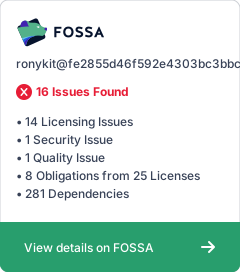
RonyKIT uses the [BSD 3-Clause License](LICENSE). [FOSSA](https://app.fossa.com/projects/git%2Bgithub.com%2Fclubpay%2Fronykit) tracks third-party licenses. See [License compliance](docs/compliance.md) for reports and scan issues.
[](https://app.fossa.com/projects/git%2Bgithub.com%2Fclubpay%2Fronykit?ref=badge_large&issueType=license)