discover · compare · collections · requirements · contribute · feed · watching · stats · help with your tokens
SloeComputers/picoX7 · source
Snapshot 0 · 2026-11-04T12:47:27Z · C++ · MIT
Content fingerprint
a3d3418b75a76a81985b1cae6deaceb0fd8808ee0c0e561acfd8131f981ac470GitHub description at capture
Software simulation of the Yamaha DX7 with a MIDI interface for the Raspberry Pi Pico
README at capture
# picoX7

A software simulation of the Yamaha DX7 with a USB and physical MIDI interface for the Raspberry Pi Pico
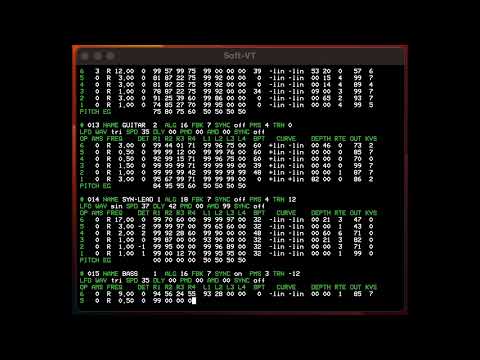
Slightly boring [video](https://youtu.be/ZSuNV67vHK8) of the picoX7 playing the Yamaha DX7 ROM cartridge 1A patches...
[](https://youtu.be/ZSuNV67vHK8)
## Status
[](https://github.com/SloeComputers/picoX7/actions/workflows/build_on_push.yml)
Done...
+ I2S (via PIO) 16-bit stereo DAC interface at 49096 Hz
+ Use of the 2nd Arm Cortex-M, 8 voices per core
+ MIDI in support via UART and USB (including SYSEX in)
+ YM21280 OPS simulation (logarithmic)
+ YM21290 EGS simulation
+ Firmware simulation including pitch envelope, LFO, key sensitivity, level scaling, amplitude modulation
+ DX7 voice patches sounding close
To do...
- Tune EGS simulation
- Rate scaling
- Portamento and glissando
Limitations...
- DAC implementation is quite different to the original. Dynamic range might be reduced?
- Hitachi 6303 (~MC6803) CPU controller and firmware are not being emulated or fully simulated
- 8 voices are on the left channel and 8 on the right ... stereo output needs to mixed to mono externally
Deviations/enhancements compared to a real DX7...
+ Each voice has it's own LFO
+ Each voice has it's own patch state (in theory when supported could load a different patch into each voice)
+ Support for 128 voice patches (DX7 had 32 internal and 32 cartridge)
See the [software blog](https://github.com/SloeComputers/picoX7/wiki/Software-Blog) and [hardware blog](https://github.com/SloeComputers/picoX7/wiki/Hardware-Blog) for more detailed progress updates.
## Hardware

[Schematic](https://github.com/SloeComputers/Hardware/blob/main/picoX7/docs/schematic_v0.05.pdf) for the above.
For more information see [README](https://github.com/SloeComputers/Hardware/blob/main/picoX7/README.md) and the [hardware blog](https://github.com/SloeComputers/picoX7/wiki/Hardware-Blog)
The Pico is significantly overclocked to 191.08 MHz to support 16 voices and generate a jitter free sample rate of 49096 Hz.
RP2350 Picos as well as the older RP2040 Picos are supported.
## Software
### Checkout
This repo uses git sub-modules, so checkout using --recurse to clone all the
dependent source...
git clone --recurse https://github.com/SloeComputers/picoX7.git
or
git clone --recurse ssh://git@github.com/SloeComputers/picoX7.git
### Software dependencies
+ https://github.com/SloeComputers/PDK
+ arm-none-eabi-gcc
+ cmake via UNIX make or auto detection of ninja if installed
+ Python3
+ SDL2 (only for native test target)
### Build
Being developed on MacOS but should build on Linux too.
Indirect build of all supported targets, rpipico, rpipico2 and native with cmake and make (or ninja)...
make
Build a single hardware target e.g. rpipico2 using cmake...
mkdir build
cd build
cmake .. -DCMAKE_BUILD_TYPE=Release -DCMAKE_TOOLCHAIN_FILE=PDK/TGT/rp2350/toolchain.cmake
make
flashable images will be found under the build sub-directory here...
build/<target>/picoX7_RPIPIOC_I2S_DAC.uf2
build/<target>/picoX7_RPIPIOC_PWM_DAC.uf2
build/<target>/picoX7_RPIPIOC_PIMORONI_PICO_AUDIO.uf2
build/<target>/picoX7_RPIPIOC_WAVESHARE_REV2_1.uf2
build/<target>/picoX7_PIMORONI_VGA_DEMO.uf2
Build the native target...
mkdir build
cd build
cmake .. -DCMAKE_BUILD_TYPE=Release -DPDK_TARGET=native
make
a runable binary image will be found under the build subdirectory here...
build/Source/picoX7_NATIVE
#### Building as a VST3 plugin
Download and unpack VST SDK. e.g. vst-sdk_3.8.0_build-66_2025-10-20.zip
The environment variable `VST_SDK` needs to be made available and point at an install of the VST3 SDK source.
Indirect build with cmake and make (or ninja)...
```
make vst3
```
Build the native target...
```
mkdir build
cd build
cmake .. -DCMAKE_BUILD_TYPE=Release -DPDK_TARGET=vst3
make
```
The built `.vst3` bundle will be under the CMake build output directory.
## License
This project is licensed under the MIT License - see the [LICENSE](LICENSE) file for details
## Acknowledgements
+ [Ken Shirriff](https://github.com/shirriff) for his very helpful series of [blogs](https://www.righto.com/2021/11/reverse-engineering-yamaha-dx7.html) reverse engineering the YM21280
+ [AJXS](https://github.com/ajxs) for their annotated [disassembly](https://ajxs.me/blog/Yamaha_DX7_Firmware_ROM_Disassembly.html) of the DX7 firmware ROM
+ The [Dexed](https://asb2m10.github.io/dexed) developers for providing an easily accessible DX7 audio reference
+ The raspberry-pi foundation for the innovative [RP2040](https://www.raspberrypi.com/documentation/microcontrollers/rp2040.html)
+ The engineers at [Yamaha](https://www.yamaha.com/en/about/design/synapses/id_009)