discover · compare · collections · requirements · contribute · feed · watching · stats · help with your tokens
KevinMusgrave/pytorch-metric-learning · source
Snapshot 0 · 2026-11-04T12:47:26Z · Python · MIT
Content fingerprint
e1884aca02249dc2ca3a0aba38178e06f05f25a60df3b9b926a2a650c43c30d3GitHub description at capture
Train and evaluate embeddings for similarity search with PyTorch. Includes contrastive losses, hard example mining, samplers, and retrieval metrics.
README at capture

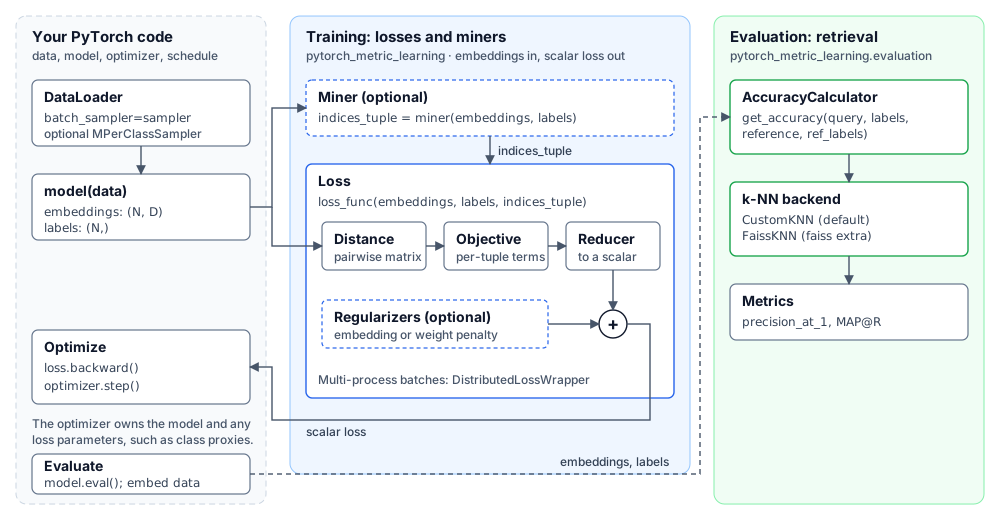
Train embedding models with composable PyTorch losses, hard-example miners,
distances, reducers, and regularizers. Use them in your own training loop for
retrieval, clustering, recognition, or learning from pairs and triplets.
[Docs for humans](https://kevinmusgrave.github.io/pytorch-metric-learning/) ·
[Documentation source](https://github.com/KevinMusgrave/pytorch-metric-learning/blob/master/docs/index.md)
[](https://kevinmusgrave.github.io/pytorch-metric-learning/imgs/architecture.svg)
## Install
Install from PyPI with uv or pip:
```sh
uv pip install pytorch-metric-learning
pip install pytorch-metric-learning
```
The core package needs only PyTorch and NumPy. Optional extras add the Faiss
retrieval backend, `pytorch-metric-learning[faiss]`, and scikit-learn for the
NMI/AMI clustering metrics, `pytorch-metric-learning[clustering]`.
Version 3 requires Python 3.12 or newer, PyTorch 2.14.0 or newer, and NumPy
2.5.3 or newer. Upgrading from version 2? Read the
[release notes](https://kevinmusgrave.github.io/pytorch-metric-learning/release-notes/3.0.0/) and look up old names in the
[migration guide](https://kevinmusgrave.github.io/pytorch-metric-learning/migration-2-to-3/). The
[version 2 documentation](https://kevinmusgrave.github.io/pytorch-metric-learning/v2/) remains available.
## A minimal training step
Your model produces one embedding per input. Equal labels identify positive
pairs; different labels identify negatives. Here a contrastive loss pulls
positive pairs together and pushes negatives apart:
```python
import torch
from pytorch_metric_learning import losses
torch.manual_seed(17)
model = torch.nn.Linear(8, 4)
optimizer = torch.optim.SGD(model.parameters(), lr=0.1)
data = torch.randn(12, 8)
labels = torch.arange(4).repeat_interleave(3)
loss_func = losses.ContrastiveLoss(neg_margin=1.4)
optimizer.zero_grad(set_to_none=True)
loss = loss_func(model(data), labels)
loss.backward()
optimizer.step()
```
The model returns embeddings shaped `(12, 4)` and labels have shape `(12,)`.
This loss L2-normalizes embeddings by default. It averages active positive and
negative pair penalties separately, then adds them. See the
[contrastive-loss contract](https://kevinmusgrave.github.io/pytorch-metric-learning/losses/contrastive_loss/#contrastiveloss) for distances,
margins, and reduction options.
## Learn more
The [documentation](https://kevinmusgrave.github.io/pytorch-metric-learning/) starts with a task index and a
[concepts overview](https://kevinmusgrave.github.io/pytorch-metric-learning/concepts/) of embeddings, tuples, distances, loss
terms, and reducers. Every component page states its signature, defaults,
tensor contract, and paper, and the [recipes](https://kevinmusgrave.github.io/pytorch-metric-learning/recipes/training/) show
complete training and evaluation code.
## Contributing
See [CONTRIBUTING.md](https://github.com/KevinMusgrave/pytorch-metric-learning/blob/master/CONTRIBUTING.md).
Thanks to all [contributors, upstream projects, and supporters](https://github.com/KevinMusgrave/pytorch-metric-learning/blob/master/CREDITS.md).
## Citing this library
If you use this library in your research, please cite the
[PyTorch Metric Learning paper](https://arxiv.org/abs/2008.09164):
```bibtex
@article{Musgrave2020PyTorchML,
title={PyTorch Metric Learning},
author={Kevin Musgrave and Serge J. Belongie and Ser-Nam Lim},
journal={ArXiv},
year={2020},
volume={abs/2008.09164}
}
```